
Gamification strategies for engaging language learners
- Activities
- Tips & Strategies
- Methodology
3 minutes



22.01.2026


Learning via some tools is much more captivating both for a teacher and students. There is a lifelong struggle about learning methods and approaches.
Sure, there is a special structure that the teachers need to stick to: warm-up, listening, reading, vocabulary, grammar, and feedback. Full stop.
But what actually to choose? Here are approaches that are frequently used:
But what’s next? Somebody still tends to call books boring and out-of-date. Instead, so much innovative stuff, like some boards or platforms, is used. Probably visualists get a real buzz out of that, as it is a matter of aesthetics.
Vice versa, some teachers are afraid to take a step back from the book as their lessons won’t be provided with good quality, they think. Many men, many minds.
It is up to the teacher what to choose, including students’ preferences and individual approach, for sure. Learning by books, or without them, using boards or not, giving self-studies or not, etc. Again, everything is so individual.
Additionally, it depends on the students’ level, experience, amount of time, tempo of studying, all in all, age. The one point is that there is no sense in rewriting the same rules, books or doing a show out of that.
No matter what approach it is, the teachers can enhance their lessons thanks to some special boosts.

Speak with Purpose in Every Lesson
Unlock effective communication techniques that help you guide, engage, and inspire your students confidently in every classroom situation.
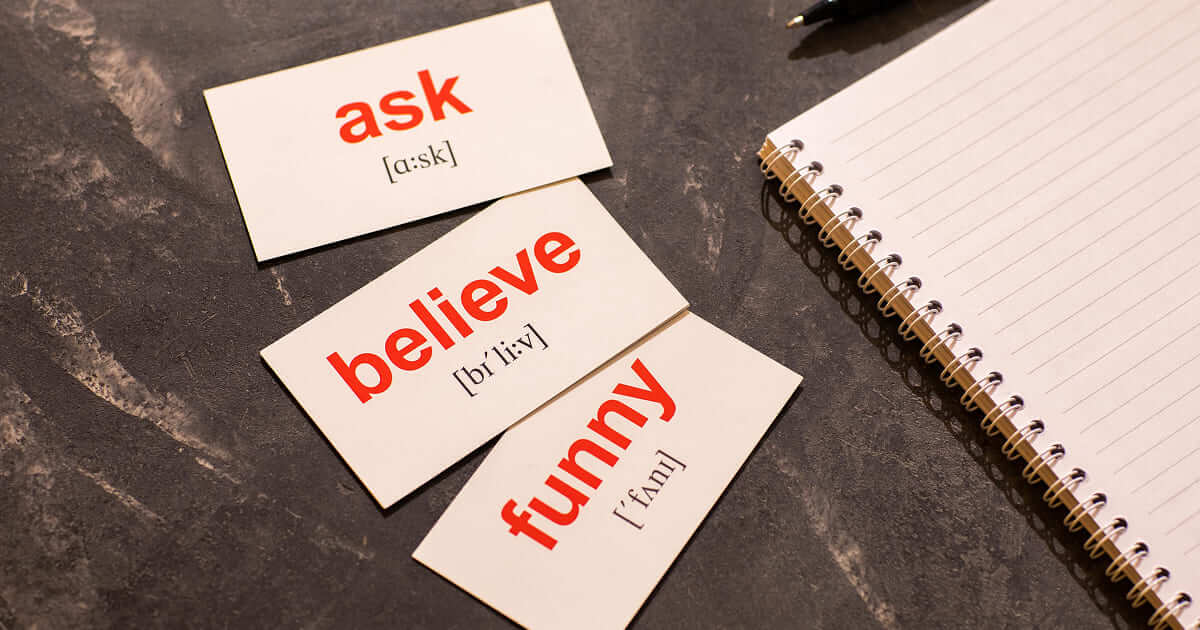
One of them is flashcards. They are just a good complement to the lessons. No matter how the lesson looks, flashcards will water it down. BTW, they can be digital as well as printed.
Why use them? Here are some reasons that will prove it.
The flashcards are not just about a word and its translation, but much more. It is great for vocabulary, grammar, speaking, and even writing activities. Now you will see how:
As it has been previously mentioned, flashcards can be different: online, printed, hand-made. It requires not so much time to make them in any of these forms. Key vocabulary and a pinch of the teacher’s willingness.
As the format is defined, it’s high time that the purpose was mentioned, too. The flashcards can be used for a warm-up or revisions, for instance.
It’s a great way to revise words from the previous lesson.
Vice versa, warm-up can be dedicated to learning new vocabulary. The teacher can prepare flashcards with new words where students, one by one, will take the flashcards and then that word, and others will guess.
The students might be shown some flashcards for 10 seconds, then the teacher takes everything away. The students’ task is to recall by drawing or writing anything they remember. Then they will say it out loud to see who has the most of the answers.
Nonetheless, the flashcards can be used for quick breaks between activities.
It will make a stressful situation for their brain, as something completely different has happened and requires the students’ attention. The teacher can use it in favour of the next tasks even more than the break itself.
As a result, the students cheer up a little bit and become more attentive.
10 Activities on Parts of Speech for ESL Students
Seriously, it is not a big deal what word to write there: whether it is an apple (A1 level) or a narrator (C2 level).
It is a big privilege with lower levels, as the teacher can show only images of words. It will be visual learning, where the students need to write the word that they see.
It is a privilege of flashcards to be adapted so easily to everyone: kids, teens, and adults. And to different types of English: medical & pharmaceutical, legal, business, banking & finance, engineering, administrative, etc.
That is a good way to memorise or revise words with diverse kinds of professions. For example, doctors can learn parts of the body and tools by doing this exercise.
The students, who learn business English, can guess and match idioms connected to their topic.
Example: one side of the flashcard has a picture (bacon on the table), the other side has the idiom — to bring home the bacon. After explaining the meaning, making a sentence, and discussing with a partner.
When students see some words again and again, they tend to remember them. These words will be stored in their long-term memory. As the students not just flip these flashcards, but also do exercises and speak, this will be into their active vocabulary.
As it is known, the human brain can not focus all the time. Now and then, our mind gets really lost somewhere in thoughts, shopping lists, to-do tasks, boss’s requirements and in the middle of nowhere. And that’s okay. No matter how interesting or expressive the teacher is, sometimes the students tend not to listen to that or not to concentrate on that.
That’s not the teacher’s fault, again. And, not the students’ one, either. That’s how anatomy works. The scientists haven’t made up anything for now on how to get rid of it completely.
However, the teachers can cut down on such short attention spans. The simple answer — flashcards. It is a breath of fresh air during the lesson.
The students switch to a completely another task, which helps them feel vigorous and makes their brain work effectively. They stay focused and interesting after doing some activity, and switch the flashcards. Then, moving on to other tasks or explanations, they still stay focused. In such a way, their attention span is expanded. No magic is used, but it was efficient.
And during such a task with flashcards, the students learn something as well. After that, their brains are even more active in consuming new information. Do not thank.
First of all, it’s good to differentiate a lesson from a lecture or a self-study, too. It is a so-called balance between individual, couple and group work. Open-class discussions are welcome. Instead of just listening or reading and then translating, students are really engaged.
The teacher should be well-armed, like an armadillo, huh, to give various tasks for their students. Then, to alternate these tasks so that the students could never predict what they gonna do.
The same with explanations: giving different ICQs will be so helpful. Instruction checking questions will be the students’ first task to handle. As they start tensing their brain up to catch the question and answer it. Only then can they start doing the task itself.
The flashcards encourage students to think, guess, and respond — not just receive information. And that’s how their interaction with the language starts. Giving tasks, completing them, asking and answering questions gives so much practice and their engagement.
In such a way, the teacher is sure that the class is working, not just having heads in the clouds. Engaging turns into learning.
Overcome English Speaking Challenges
Learn practical strategies to help ESL students overcome common speaking fears, build confidence, and improve fluency with real classroom tips.
That’s a great feature that apps do have. Either with a subscription, or without, they have trials to learn the flashcards, play some games like blast or folding blocks, do matching exercises or pass tests.
The tests are of a different level of difficulty: choosing the correct option, writing the translation, choosing true/false, etc.
Doing all of that, the system tracks their progress, showing how much time they spend on learning, and how much is learnt. There is a streak that the students will be eager to have and compete with each other.
Of course, there are special gifts or badges for those who do not skip days of learning. Getting awards is always pleasant. In case somebody forgets about their streak, the app will remind them via email. Convenient, isn’t it?
It seems like something minor, but the students have their mood and motivation boosted. And, this is just a background benefit. As the hidden jam beyond all of these awards and badges is memorising new material.
Flashcards are for remote learning, beyond the question. Stuck in traffic, waiting in the queue? That’s high time students revised words by flipping flashcards.
Without any jokes, it’s convenient as they can recall it any time outside the lesson. The teacher can share some links (if they’re online) and their students can have them at hand in any free minute: commuting, doing some routine at home, before sleep. It’s practical as it can be used any time and anywhere.
The students can have the same flashcards in a paper version.
The process of creating such flashcards boosts memory as well. They prepare material they are going to write on both sides, actually write and learn at the same time. Not rocket science. Just visual memory. And it thrives. The students may learn everything by heart just by creating these flashcards.
So, learning has started on its own.
The flashcards need to be stored somewhere. If they are paper ones, it is a great representation for the students of how much is done. The more they see, the more they know. Simple truth.
Such a pile of flashcards might look creative, too, and serve as decor in the classroom, not only a go-to tool.
Talking about digital flashcards, the students save links each time and store them somewhere. The teacher can make a special folder that will be divided by topics or units. It is great when everything is so well structured and available for ESL learners.
And again, it repeats. They spot a lot of links and take pride in completing so many of those sets of cards.
Continuing the previous topic of being independent learners, students can choose whatever pleases their eye. It is well-known that some colours, sizes and fonts do in favour of us. But it might be different for everyone.
Here is how it generally works and what the teachers can bear in mind for their lessons.
The simple essence is that some colours do affect us, can sharpen our focus and facilitate the comprehension and learning process overall.
Warm and gentle colours like blue can calm down, taking away stress and anxiety. Comfortable atmosphere makes for a better memorising.
Light blues, white and green, together with simple fonts, make it easy on the eyes. Fonts should always be easy to read, full stop. No creative fonts or constant yelling bold are needed. Otherwise, the students won’t be able to concentrate on that.
Yellow and orange are cheerful colours that might catch attention, as well. It is important not to overuse it; just highlight something important, like prepositions, endings, for instance.
Colours like red, orange might be used for highlighting special words, especially exceptions. Bright and vibrant colours excite a lot. Do not use these colours as the only. It might overload students. Using that for some special words will be a sign to pay attention. Especially, the teacher can put an exclamation mark and make it red.
In a nutshell, it is cool to develop your own system with students where they know that a certain colour means something for them. Like purple is a word of a higher level, so it would be impressive to remember that and use it in their speech. Orange — pay attention to the pronunciation, and so on.
Reasons to use the flashcards are countless. It proves its quality, practicality, and simplicity in everything. It wastes almost no time, but has so much use for the students. So, being a devoted teacher, you understand that it is a cool-to-go tool in the ESL classroom to use.

Tetiana Melnychuk
Author
Teacher of General English
Comments
Leave your comment